
Commercial Access Control Systems for DFW Buildings
Consultative design of commercial access control, video surveillance, intrusion detection, and visitor management systems for DFW manufacturing, CRE, and private school facilities.
A commercial access control system in DFW typically combines card readers, mobile credentials, and in higher-security environments biometric readers, into a single platform that logs every entry event and integrates with on-site video surveillance and central station monitoring. Beyond credentials and cameras, a complete physical security system for a commercial facility includes intrusion detection and visitor management: four interconnected components that only deliver their full value when they are designed together rather than bolted together after the fact.
The right credentialing choice depends on the environment. HID-format cards and ProxKey fobs are the industry standard for most commercial applications. Mobile credentials via NFC or Bluetooth suit high-turnover environments where issuing and revoking physical cards becomes a labor problem. Biometric readers serve high-security zones where a card or phone alone is not enough. Many buildings need more than one of these approaches on the same floor plan.
My background covers all three DFW buyer types who reach out to me about physical security. Manufacturing operations managers along the I-35 and Alliance corridor need zone-based access that maps to shift schedules and separates contractors from permanent staff. Property managers with multi-tenant office buildings need cloud-based systems that let them provision credentials remotely and manage visitor traffic at the lobby level. Private school administrators increasingly need visitor management that satisfies what Texas SB 11 established as the public school standard. Each of those is a genuinely different scoping problem.
I have spent 17 years in this industry, nine of them running service delivery for more than 350 customers before moving into account management. That operations background shapes how I approach a scoping conversation: I know what systems look like after installation, which means I know where specs tend to drift from field reality. A security assessment starts with a walkthrough of your facility. Contact me to schedule one.
How Commercial Access Control Actually Works
A commercial access control system controls who enters which areas of a building through three layers: identity (who you are), credential (how you prove it), and authorization (which doors open for you). At each controlled entry point, a reader receives the credential, passes it to a controller, and the controller checks the access management software to determine whether that credential is permitted at that door at that time. If it is, the lock releases. If it is not, the reader logs a denied attempt. Both events are recorded.
The access management software is where the system lives day to day. It stores the full access log, manages credential permissions across every door in the building or campus, sends alerts when credentials are denied or when specific doors are held open past a threshold, and integrates with camera and alarm systems to give whoever manages security a single view of activity. A door forced open at 2 AM generates an entry alert, tags a camera clip, and signals the monitoring center without requiring anyone to piece those events together manually.
Four components make up a complete physical security system: access control, video surveillance, intrusion detection, and visitor management. They are worth understanding separately because they each have distinct design considerations. The buyers who contact me most often need all four, and they perform better when the design accounts for all of them from the start rather than adding components as separate projects later.
The compliance value of a correctly integrated system is real, whether for OSHA documentation in a manufacturing environment, insurance audits for a commercial property, or school safety requirements for a campus that manages visitor access during the school day.
Access Control Credentialing: Card, Mobile, and Biometric
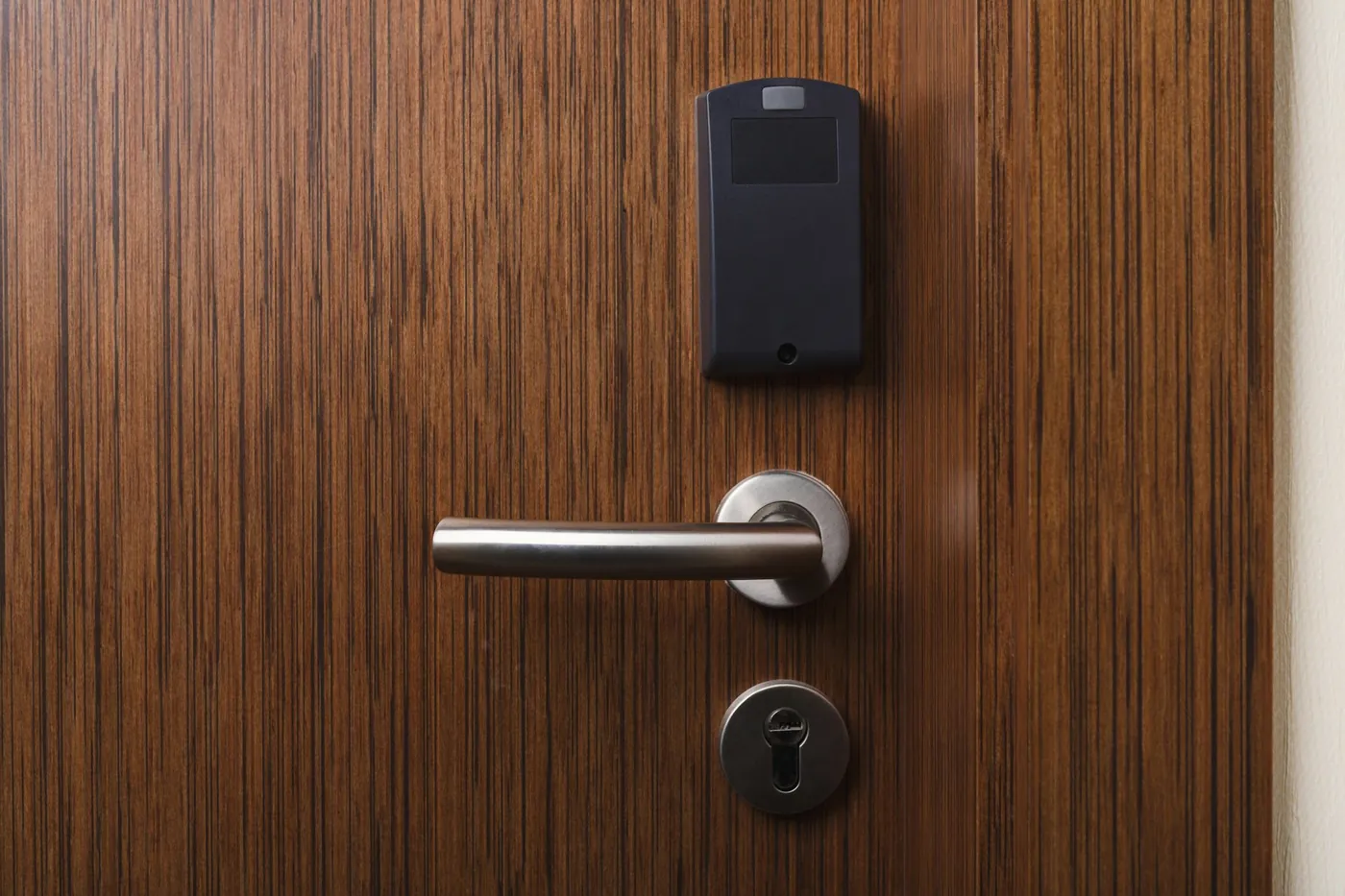
Card-based credentials use HID-format cards and ProxKey fobs as the industry standard for commercial door access control. A card reader at a controlled entry point reads a proximity or contact credential, validates it against the access controller, and releases the lock. Cards are the right choice for most commercial applications: they cost less per credential than mobile or biometric alternatives, they are straightforward to issue and revoke, and facility staff know how to use them without any onboarding. ASIS International standards for access control design treat card credentials as the baseline for commercial building security.
Mobile credentials deliver access via NFC or Bluetooth through a smartphone rather than a physical card. The management advantage matters in environments where staff turns over frequently, where a building has multiple sites managed centrally, or where credential issuance and revocation need to happen remotely without shipping a card. A facilities director at a multi-site commercial real estate portfolio can provision a new tenant’s access from a browser or mobile app in the time it would take to mail a card. Mobile credentials run on cloud-based access management platforms, which also provide the remote reporting and administration that multi-building operations need.
Biometric access control uses fingerprint readers, palm vein readers, or facial recognition to verify identity at the door. The case for biometric is strongest in high-security zones: restricted manufacturing areas, pharmaceutical storage, server rooms, or any space where the consequence of an unauthorized entry justifies the additional cost and throughput considerations. Biometric readers cost more per door than card readers, and at high-traffic entrances the read time adds up at shift change. They also carry privacy considerations in some Texas employer contexts that are worth reviewing before specifying them at a main building entrance rather than a restricted zone. Multi-factor authentication, such as a card plus a PIN or a mobile credential plus biometric, is available for the highest-security applications where a single credential type is not sufficient.
The credential choice is a design decision, not a product preference. Different doors in the same building often call for different credentialing methods, and getting that mix right at the spec stage avoids the retrofitting that happens when a facility manager realizes the main entrance biometric reader is a bottleneck during peak hours.
For manufacturing plants and distribution centers along the I-35 and Alliance corridor, access control requirements include zone-based restrictions by shift schedule, separate credential tiers for contractors versus permanent staff, and camera coverage of loading docks and material storage areas. The full scope of how I approach manufacturing and warehouse access control in DFW is on the manufacturing industry page.
Commercial Video Surveillance and Camera Systems
IP cameras are the current commercial standard for video surveillance, replacing analog CCTV as the default for any new installation or significant upgrade. Network-connected and centrally managed, an IP camera system scales across a building or campus without the wiring constraints of analog, and feeds a single management interface rather than separate DVR boxes per zone. For DFW commercial buyers comparing proposals, the relevant question is not whether to use IP cameras but which resolution and coverage pattern fits the facility’s actual needs.
Resolution determines what footage is actually useful for. A 4K camera at a parking structure entrance captures license plate numbers reliably; that same camera covering an interior hallway adds storage cost without adding operational value. 1080p cameras handle interior common areas, hallways, loading dock overviews, and most exterior coverage zones well. A business security camera system that applies one resolution standard across every location is either overspending on interior coverage or underspecifying at the perimeter. Matching resolution to the use case is where a camera design fits the budget or strains it.
NDAA Section 889 prohibits cameras from specified Chinese manufacturers in facilities that have federal contracts or operate in the DoD supply chain. In DFW, this matters more than most local integrators acknowledge. Manufacturing facilities in the Alliance corridor, logistics companies serving government clients, and schools that receive federal funding all need to verify that their commercial video surveillance system is NDAA-compliant. If your facility has any government contracts or works with DoD supply chains, your camera system needs to be NDAA-compliant. Many DFW manufacturers are in ITAR or CMMC scope without realizing their camera system creates a compliance gap. For facilities without current government contracts, NDAA compliance is still a reasonable default: if the client mix changes, a non-compliant camera system becomes a remediation project.
When door-open events from the access control system are tied to video clips at controlled entry points, every access log entry can be matched to a camera frame. An incident review that used to require pulling hours of footage to find one event takes minutes when the camera and access system timestamps are synchronized. Verified video alarm response, available through a UL-listed monitoring center, extends this further: when a motion alarm triggers, the monitoring center can pull camera footage before dispatching, which reduces false alarm calls and the DFW police false alarm fees that come with repeated unnecessary dispatches.
Intrusion Detection for Commercial Properties
An intrusion detection system for a commercial property typically includes door and window contacts, passive infrared motion sensors, glass-break sensors for exterior glazing, and dual-technology sensors for higher-sensitivity zones where false alarms from HVAC movement are a recurring problem. Each sensor type covers a different failure mode: a door contact catches a forced entry, a motion sensor catches movement inside a secured space, a glass-break sensor catches an entry attempt before the door is reached. A well-designed layout covers all three.
The NIST Cybersecurity Framework’s detect-respond-recover sequence applies to physical security as directly as it does to IT security. An intrusion detection system is the detect layer for a building’s physical perimeter: it identifies a breach event, signals a response through the monitoring center, and generates the documentation needed to support an insurance claim or a police report in the recover phase. I reference the NIST framework when talking to DFW manufacturers and logistics companies because it is the language their IT and compliance teams already use, which makes the conversation about physical security investment easier to have across departments.
DFW industrial corridors have real commercial burglary exposure, particularly warehouse and distribution facilities along I-20, I-35, and the Alliance corridor. Camera coverage of a loading dock perimeter is a deterrent. Sensor coverage of the same perimeter generates an alert while an event is still in progress. Both are needed; cameras alone are not a substitute for sensors at the perimeter when the building is in a secured state after hours.
Intrusion detection connects directly to central station monitoring, which is covered in the next section. One integration point worth noting here: in a correctly designed system, an intrusion alarm triggered in a specific zone can automatically lock down the access control points serving that zone, limiting egress from the area while the monitoring center determines the appropriate response.
Visitor Management Systems for DFW Office Buildings and Schools
A visitor management system replaces paper sign-in logs with a digital process that photographs visitors at check-in, prints a time-stamped badge with name and photo, notifies the host by text or email when their visitor arrives, and maintains a searchable audit log of every visit. Visitor management systems for commercial buildings range from digital badge-printing kiosks to cloud-based platforms that run background checks and notify hosts by text, with NDAA-compliant cameras covering building entries. The audit log is what makes the system useful beyond the lobby: when an incident occurs in a multi-tenant building, the visitor record for that day is the first thing a property manager needs.
For commercial real estate and multi-tenant office buildings in DFW, the visitor management layer belongs at the building lobby level, separate from tenant-level access control. A visitor kiosk checks in the visitor, prints a badge, and notifies the tenant contact whose guest has arrived, without the tenant needing to staff the lobby or grant the visitor building-level credentials. Cloud-based platforms allow visitor pre-registration: expected visitors complete their information before arriving, reducing lobby wait times during busy arrival windows. Property managers overseeing multi-tenant office buildings in DFW face a specific version of this problem: tenant turnover means frequent credential adds and revokes, lobby visitors need a management layer tied to the building’s access platform, and the property manager needs reporting without having to call the tenant. The full approach to building access control for DFW property managers is on the commercial real estate industry page.
For private schools and campuses, Texas Senate Bill 11 (2023) set the standard for controlled entry vestibules and identity verification for visitors before they access campus. The law primarily governs public schools, but the standard it establishes has become the reference point that private school procurement committees use when evaluating their own visitor management systems. A digital visitor management system that photographs visitors, cross-references the registered sex offender database, and prints a time-stamped badge satisfies the verification standard that SB 11 requires of public schools. An increasing number of private school boards in DFW are implementing the same standard proactively rather than waiting for a legislative requirement to apply directly to them. Texas SB 11 has pushed private school administrators across DFW to formalize what many had previously handled with a paper sign-in log. The full picture of school access control and visitor management DFW is on the private schools industry page.
Visitor badges can be tied to temporary credentials in the access control system, granting the visitor access to specific areas for the duration of their visit, then automatically expiring at the end of a set time window. No manual credential revocation step required from staff.
IoT, Managed Services, and Mobile Integration
In commercial security, IoT refers to the network connectivity layer that links access readers, cameras, sensors, and alarms to a cloud management platform. For a property manager or facilities director, this means access logs, camera feeds, and alarm status are accessible from a browser or mobile app rather than requiring an on-site visit to pull a report. A building administrator can grant a contractor a temporary credential, verify the contractor badged in, and confirm the door closed behind them, all from a phone, without being in the building.
Mobile access management matters most for multi-building commercial real estate portfolios and manufacturing operations with multiple facilities. Centralized cloud-based credential management means a single administrator can manage access across buildings without maintaining separate systems for each location. Credential provisioning for a new hire, or revocation for a departing employee, happens in one place and propagates across every access point in the portfolio.
For DFW facilities that want to move physical security from a capital equipment purchase to a predictable monthly cost, subscription-based security services bundle hardware, software, central station monitoring, and maintenance into a single line item. The full model, including what is covered and how pricing is structured, is on the managed services page. The buyer benefit is OpEx predictability: instead of a large capital outlay for hardware every seven to ten years followed by separate monitoring and maintenance contracts, the monthly cost is fixed and includes equipment refresh cycles. For facilities directors working within annual operating budgets rather than capital planning cycles, this is often the more practical path.
Active Central Station Monitoring
Central station monitoring is a 24/7 staffed facility that receives alarm signals from access control, intrusion detection, and video systems, and dispatches police or fire when response thresholds are triggered. When an intrusion sensor trips at a manufacturing facility at 3 AM, the monitoring center receives the signal, assesses the alarm based on available camera footage, and places the police call. The facility manager receives a notification. Everything is logged with timestamps.
UL-listed monitoring means the monitoring center has been audited by Underwriters Laboratories for response times, staffing levels, and operational standards. It is buyer-recognized shorthand for a monitoring operation that meets a defined performance baseline. Some insurance carriers require UL-listed monitoring as a condition for commercial security premium discounts. Government facility requirements and some commercial lease agreements specify it as well. When comparing monitoring contracts, “UL-listed” is the specification that distinguishes a properly audited monitoring center from a self-certified one.
Verified video alarm response changes the economics of alarm dispatching. When a motion alarm triggers, a monitoring center with verified video capability pulls the camera feed for that zone before deciding whether to dispatch. A verified threat gets a faster, more targeted response. A false alarm gets confirmed without a dispatch. DFW police departments have moved toward charging fees for repeated false alarm responses, and those fees accumulate quickly for facilities with dense sensor coverage and no video verification layer.
A UL-listed monitoring center receives signals from both access control and intrusion detection, and in facilities where I have scoped the full physical security stack, from fire alarm and life safety systems through access control and cameras, the monitoring center ties all three together. A forced door in a restricted zone at 2 AM generates a simultaneous access alert and camera pull; a smoke detector activation generates a fire alarm response, all from one monitoring contract.
How I Scope a Security System for Your Facility
I start with a walkthrough of the facility. Not a phone call, not a product presentation. A walkthrough where I map every entry point, identify high-value zones and restricted areas, locate camera blind spots, and assess whatever existing infrastructure is already in place. The goal is to understand the building before recommending anything. A scope document that comes from a walkthrough reflects what the facility actually needs; one that comes from a phone call reflects what the client describes, and those two things are not always the same.
For manufacturing facilities, the scoping conversation covers zone-based access control tied to shift schedules, separate credential tiers for contractors versus permanent employees, camera coverage of loading docks and material storage, and OSHA documentation readiness. A 200,000 square foot production facility with three shifts, rotating contractor crews, and a loading dock that operates around the clock is a different scoping problem than a 20,000 square foot office building, even if both need access control, cameras, and monitoring. The system architecture has to match the operational reality, including who manages credentials day to day and what happens when the IT contact who set up the system moves on.
For commercial real estate, the scoping conversation centers on multi-tenant credential management, common-area camera coverage, lobby visitor management, and whether the property manager needs single-system administration across multiple floors or buildings. A Class A office building with 40 tenants and a staffed lobby has different access architecture requirements than a suburban multi-tenant property with an unstaffed entry and high tenant turnover. I have closed maintenance contracts at the $500K level for CRE accounts, which means I understand what these systems look like not just at the proposal stage but through years of operation and tenant cycling.
For private schools, the scoping conversation starts with Texas SB 11 readiness: whether the campus has controlled entry vestibule design that separates the visitor check-in point from the rest of the building, whether the visitor management system satisfies the identity verification standard, and whether the camera coverage provides the documented evidence a school safety audit requires. Private school administrators are making capital planning decisions that will serve the campus for a decade. They need a scope they can defend to the board, not a proposal that undersells the full requirement.
The detail that matters most in this section is the one buyers ask me about directly: I spent nine years managing service delivery for more than 350 customers before moving into sales. I know what systems look like after the installer leaves, which means I know where specifications drift from field reality and which oversells create problems three years into a monitoring contract. That perspective shapes how I scope. I will tell you when a simpler system is the right answer, and I will not specify six access control panels for a building that needs three.

Backed by [Employer]: SDM Systems Integrator of the Year, SCN Top 50, 70+ US locations. I bring enterprise-scale resources to DFW commercial accounts with the local accountability a national contractor’s regional office cannot.
Frequently Asked Questions About Commercial Access Control in DFW
How does commercial access control work?
A commercial access control system controls who enters specific areas of a building by requiring an electronic credential at each controlled door. When a valid card, mobile credential, or biometric scan is presented at the reader, the door controller releases the lock and logs the entry event. The management software stores those logs, manages which credentials open which doors, and integrates with video surveillance and intrusion alarms.
What is the best access control system for a multi-tenant building in Dallas?
Multi-tenant office buildings in Dallas typically need a cloud-based system with mobile credential support so property managers can provision and revoke tenant access without issuing physical cards. Key requirements include tenant-level access logs for each suite, common-area camera integration, a visitor management layer for the lobby, and a monitoring connection. Card-based systems work for smaller multi-tenant properties. The right answer depends on how many tenants, how frequently staff turns over, and whether the property has a staffed lobby.
How much does a commercial access control system cost for a DFW business?
Cost depends on four variables: number of controlled doors, credential type (card systems cost less per door than biometric readers), whether the system includes video integration and central station monitoring, and whether it is a capital purchase or a subscription-model deployment. A small office with 3-5 controlled doors and card credentials is a different project than a 200,000 sq ft manufacturing facility with zone-based access and shift-schedule management. The right starting point is a site walkthrough to scope the actual requirement.
Do I need an NDAA-compliant camera system for my DFW facility?
If your business has government contracts, works in the DoD supply chain, or is a public or quasi-public institution such as a school or government-adjacent tenant, NDAA Section 889 compliance is required for your camera system. Many DFW manufacturers and logistics companies are in ITAR or CMMC scope without realizing their camera system is non-compliant. For facilities without government contracts, NDAA compliance is still a best practice: it eliminates one category of future risk if the facility’s client base changes.
What visitor management system works for a DFW office building?
Digital visitor management systems for DFW office buildings range from self-service kiosks that print badges and notify hosts by text, to cloud platforms that allow visitor pre-registration, background checks against registered offender databases, and temporary access credentials tied to the building’s access control system. The right system depends on daily visitor volume, whether the building is staffed or unstaffed, and what the tenants’ clients expect when they arrive.
What are the Texas school visitor management requirements under SB 11?
Texas Senate Bill 11 (2023) strengthened school safety requirements for public schools and has influenced procurement decisions at private schools across DFW. The law mandates controlled entry vestibules and identity verification for visitors before access to campus. A digital visitor management system that photographs visitors, prints time-stamped badges, and maintains an audit log satisfies the verification standard. Some private school boards have adopted the same standard voluntarily ahead of any legislative requirement.
What is the difference between intrusion detection and access control?
Access control determines who can enter a space and logs every entry event. Intrusion detection monitors for unauthorized activity when the building is closed or in a secured state: door contacts, motion sensors, and glass-break sensors trigger an alarm if activated outside permitted hours. The two systems integrate: an intrusion event in a restricted zone can automatically lock adjacent access control doors and trigger a camera pull at the monitoring center.
Start With a Security Assessment
A security assessment is not a sales call. I walk the facility, map the access points, identify camera blind spots, review whatever existing infrastructure is in place, and come back with a scope document that reflects what the building actually needs. No brochure, no product catalog. I serve DFW manufacturing plants, commercial office buildings, and private school campuses across the metroplex, including buyers who prefer to discuss facility requirements in Spanish.
Reach out at (510) 305-5522 or use the contact form to request a security assessment.